


Rappel Modes TESTED!!!
Canyon Rope Systems A HowNOT2 Course Episode 8 of 10 This is a free course featuring Brent Roth about different ways to set up rappels through a canyon. This considers ease of rigging, abrasion, ease of rescue and how efficient it is to move people through the canyon. Our courses are A-Z content in blog format, glued together with an overarching blog we call a textbook. A blog format is easy to read, easy to update, and easy to translate. Be sure to begin at the TEXTBOOK and at the end of each episode we'll point you to the next. Rappel Friction Tests Brent set up a mechanical disadvantage so he could put more weight than himself on different lowering devices in different modes. How much friction do the different RAPPEL devices using the same 8mm rope on every device. The tail of the rope was weighted with a 5lb weight to simulate you lightly holding the loose tail during a rappel. For example, if you rappelled with a Palikoa Pivot in the fastest mode, it only takes 30lbs but with it set behind the carabiner, or high friction mode, (not counting the “on the fly” options you have), it took 110 lbs or almost 4x as much. We tested 7 devices over 20 different ways total. Since you have to see the context for it to make sense, you'll have to watch the video instead of reading each of the results. ☠️ PIRANA DESCENDER RECALL ☠️ If you watched to the end of our video you saw how the Petzl Pirana catches the end of the rope in the spur of the device. This may not seem like an issue, but it is a very real danger in canyons with moving water. It's especially dangerous when you expect to come off the end of your rope and swim out of a water hazard. Death Valley Mosaic Canyon Accident From a FB post by Adolfo Isassi Sad fatality in Death Valley. As with many accidents, an opportunity to learn and avoid future accidents under similar circumstances. In this case, it looks like the accident was due to a combination of: Canyoneering solo Rappel rope was short Error or mishap while passing a knot If you have a teammate in a situation like this, where a rope is, or may be short, all you have to do is rig releasable, set the rope length, add more webbing/rope/cord to the pull side....Done. If you are solo, now you need to decide if you are doubling your rope, or blocking it for a single strand rappel. It is unclear what the victim decided. Whatever the decision, webbing was added to the rope to attempt a "knot pass". This particular situation brings 3 unusual tasks: Joining rope and webbing for a live load bearing purpose (rappelling) Rigging a rappel device with webbing and locking it off Rappelling on webbing Given that the fall was about 30 feet, there is a good chance that the fall itself did not result in death. The combination of canyoneering solo and no Satellite SOS device resulted in no chance for prompt first responder assistance. Condolences to family and friends. Report: 54-year-old solo canyoneer dies in rappelling accident, Death Valley officials say The system may have been rigged by joining the two materials with an overhand on a bight for the webbing and a sheath-bend on the rope side. This is probably the most economic way to connect the rope with the webbing. I have never thought about doing this, but once someone has ended up in this situation, joining webbing and rappelling on it, I wanted to know what the friction would be... So I ran it through the same test we did before... Compare this test to the previous one with the SQWUREL in the same friction mode at 14:26!!! 👇🏼👇🏼👇🏼👇🏼👇🏼👇🏼👇🏼👇🏼👇🏼 10% Supports HowNOT2 They sell canyon gear and ship internationally What's Next? This course is free but not free to make. If it really helped you, please consider SUPPORTING US.
How strong is a Petzl 8 descender?
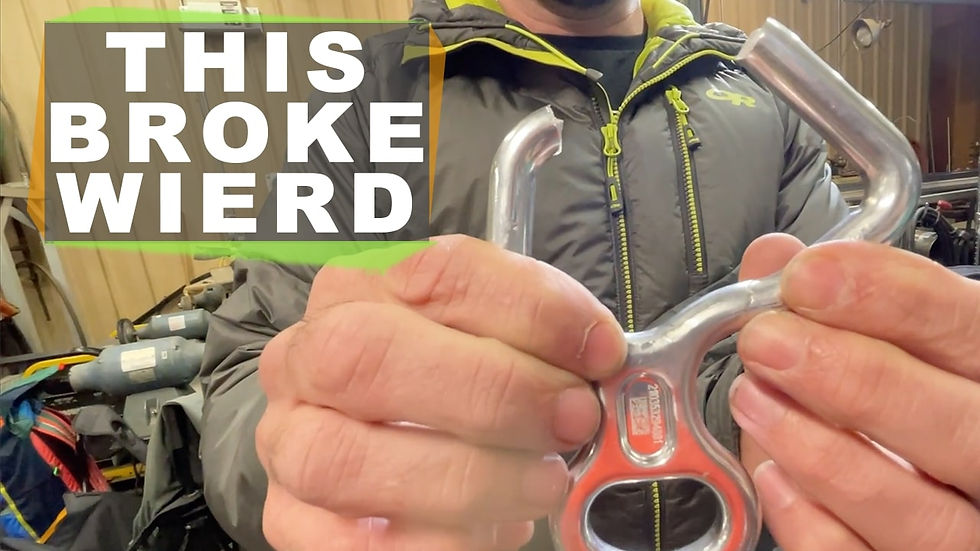
Canyon Rope Systems A HowNOT2 Course Episode 9 of 10 This is a free course featuring Brent Roth about different ways to set up rappels through a canyon. This considers ease of rigging, abrasion, ease of rescue and how efficient it is to move people through the canyon. Our courses are A-Z content in blog format, glued together with an overarching blog we call a textbook. A blog format is easy to read, easy to update, and easy to translate. Be sure to begin at the TEXTBOOK and at the end of each episode we'll point you to the next. Hardware Break Tests We broke a Petzl 8 and tried to break a Palikoa Pivot from Glacier Black. I say try because I broke a sling in an 88kn configuration only to find out nylon doesn’t 4x when you quadruple up the slings. Then we broke a 40kn steel carabiner at 48.76kn, then an broke an aluminum quick link at 47kN which is amazing because it is rated for 25kN. Bobby found some off-brand 72kN steel carabiner that Brent used and that is what finally broke the eye of the Palikoa Pivot at 46.50kN after being pulled 4 times. 😂 The Petzl 8 was girth hitched with a Dyneema sling on the small eye but broke into a tuning fork (554 hz C# if you must know) when a carabiner being pulled THROUGH the aluminum at 28.17 (rated for 25kN). They pulled the big eye apart on a new 8 and it broke like you see in the thumbnail at 26.68kN. With carabiners in both eyes, it broke at 35.56kN. Super strong enough! Brent cut the Dyneema sling to see if the girth hitched master point was redundant. It starts to slip at 4-5kN and continues to slip until failure at 2-3kN. Girth hitched master points are "Barely Redundant Enough". This is important to know because this a good way to rig to unlinked bolts, but you should know the limitations of your rigging. Using the 8 gives you a nice master point to rig to and a place for people to clip in. 10% Supports HowNOT2 They sell canyon gear and ship internationally What's Next? This course is free but not free to make. If it really helped you, please consider SUPPORTING US.

EMO vs MMO Break Tests + Stone Block, Clove Hitch and 8 Block
Canyon Rope Systems A HowNOT2 Course Episode 10 of 10 This is a free course featuring Brent Roth about different ways to set up rappels through a canyon. This considers ease of rigging, abrasion, ease of rescue and how efficient it is to move people through the canyon. Our courses are A-Z content in blog format, glued together with an overarching blog we call a textbook. A blog format is easy to read, easy to update, and easy to translate. Be sure to begin at the TEXTBOOK and at the end of each episode we'll point you to the next. Knot Block Break Tests Will knot blocks slip through the rappel ring? Is the MMO (Munter Mule Overhand) or the EMO (Eight Mule Overhand) stronger? A stiff rope is hard to cinch down a clove hitch on a carabiner well but we found it can cinche down so well that you can’t get it undone. Even a slippery Dyneema rope holds a clove hitch in our slow pull tests. Knots will pull through the rappel ring, but if you install a carabiner in the knot it will break the rope at “full strength”. All these tests use a new Sterling C-IV with technora sheath and rope broke between 10-11kn. When you are rappelling at 1-2kn you are super good enough... assuming you don't drown, have a rappelling accident or cut through your rope with abrasion. Be careful canyoning! Spoiler Alert: EMO and MMO break at the same force. The stone knot was easy to undo regardless of the force we took it to. 10% Supports HowNOT2 They sell canyon gear and ship internationally You are at the End! Congratulations on getting through all that! Now what? 👇🏼 👇🏼 👇🏼 👇🏼 👇🏼 👇🏼 👇🏼 Continued Education V7 Academy We made our HowNOT2 course because this material wasn’t available online in this way and we like to help spread knowledge in the extreme sports community. There is another great canyon resource that can show you how to move down the canyon, the stuff you need and how to be a better participant on a canyon trip. The first V7 course is free and we HIGHLY RECOMMEND you take it. Their 2nd course is more advanced and is only the cost of a rope. Go sign up and see if you benefit from the first course! Seattle Mountaineers Canyon Program For local training and information, the Seattle Mountaineers has a canyon program that is a great way to get plugged into canyoning in the PNW. Their curriculum follows the V7 course and has great hands-on training with a great group of people…. Mazamas Canyon Program If you are a bit farther south, the Portland Mazamas has a canyon program as well. Kevin Clark wrote an extensive book, Canyoning in the Pacific Northwest: A Technical Resource, that is actually available from a lot of places these days (NorHex in Portland, Ascent Outdoors in Seattle, Valhalla Outfitters up in Squamish -- and a bunch of others including Imlay, On Rope Canyoneering, Adventure Plus, CanyonZone, Canyon Store, etc. Amazon delivers fast, but one can probably get it a bit cheaper and help support local canyon businesses at the same time. 🙂 Proceeds from this book support the Mazamas Canyon Program. American Alpine Institute Canyon Program AAI is starting a new hands-on canyoning program in Washington with Brent Roth. Contact them for more details about courses and scheduling. OR Check out our other free COURSES or head back to the TEXTBOOK for this one. This course is free but not free to make. If it really helped you, please consider SUPPORTING US.

Corroded Caving Carabiners and Hangers Break Tests
Hunter Campbell sent us some old corroded cave gear and we pulled it till it snapped. It's interesting how gear left inside of the earth will get so gnarly. I'd expect that for any non stainless steel, but the aluminum is what is the most interesting. There is also a surprising amount of home made gear in caves and it was nice to test some of that too. OUR RESULTS The Camp 22 rated for 21kN broke at 15kN. The blue carabiner rated for 21kN broke at 20kN. The omega rated for 31kN broke at 29kN. The other omegas broke at 26kN and 27kN. The Black Diamond carabiner rated for 24kN broke at 26kN. And the unknown 23kN carabiner broke at 25kN. The Petzl D Link rated at 15kN broke at 22kN 10% supports us The homemade hangers broke crazy low. The normal looking one broke respectably at 23kN but the others broke at 7kN and 10kN which is way too low for a hanger. And the weird titanium one had such a small bolt that the bolt snapped at 10kN. Read the bolting bible at https://www.hownot2.com/boltingbible Behind the Scenes I couldn't make it to the lab when John Fioroni from ExtremeGear.org was in town, so Bobby met up with him and broke our last bit of cave to do list. These carabiners and old hangers were sitting around for a year because we did the video below and then got really busy with the drop tower and the Dano project and moving out of state. It's nice to have a handful of old gear tested just as a rough idea on what stuff does over time. Check out the other stuff we broke from Hunter that he found in a cave.

BIG climber lead falls for science. You won't believe the forces!
290lb (131kg) Climber Falls for Science Tanner is 290lbs or 131kg and he climbs. We wanted to know what forces he gets when he falls on his gear so I sent him 3 LineScale3s and showed him how to film an episode. This was an amazing experiment of a test being done for HowNOT2 without me there. Tanner worked so hard to make this happen and Gritstone Climbing Gym was gracious enough to not only let him do this but Chris and Matt, the owner and manager, helped film and fall for science. Thank you Celine Gissot for this graph below. Grab a LineScale 3 with a discount code at our SHOP page 10% supports us They sell harnesses, shoes and ropes Behind the Scenes Tanner reached out to me in February 2022 after I said "ideally no one is over 1kn". I didn't realize how many bigger than 160-180lb or 72kg to 82kg climbers there were until I said that and got the lash back. I didn't mean to say no one should be heavier than a kN as a general statement. Context is important. When sport climbing, the gear is likely super good enough; however, when trad climbing, the forces attained in these tests are at or above the MBS of some pieces of gear, so you have to be mindful of that in order to be safe. I think understanding what forces are like in a real world context can help people make decisions about the gear they trust their lives to. Since Tanner was willing and so many were curious, we decided to test it. It took 4 months to get him LS3s and have him do the tests and I expedited the edit. It's a lot of work to put these together but so worth it. Put in the comments of the video what you want to see tested next. After Posting Thoughts People loved it. I'm glad this helped heavier climbers who were concerned about the forces. There is a limit to gear but you don't have to fear it. Check out our other gym fall videos.
