

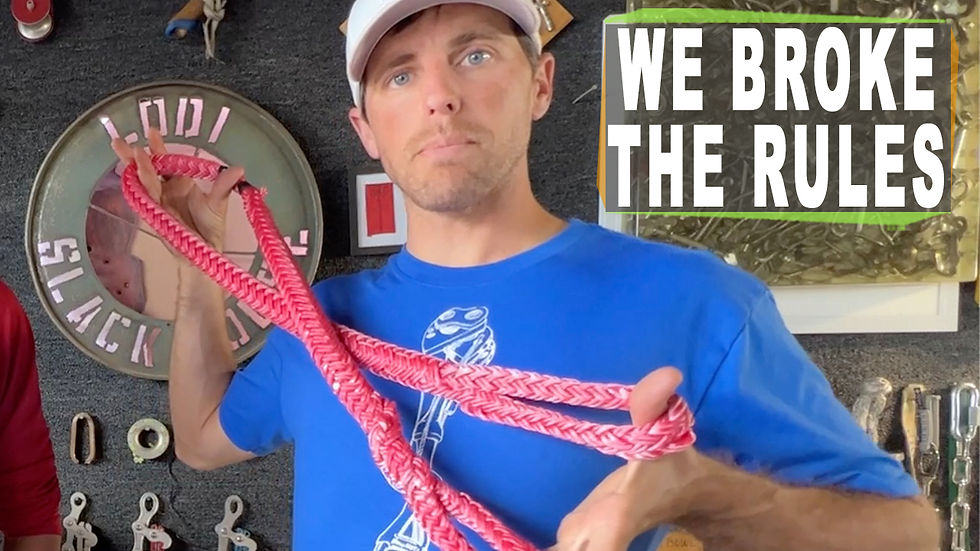
This Arborist Rope Scared The S#!% Out Of Me
In celebration of ExtremeGear.org now stocking a full line of arborist gear we decided to break of some of it. In this video we break Samson 16mm (5/8") Tenex-TEC in a few different configurations, an arborist harness, and some VT prussiks donated by Test Results Tenex-Tec is a polyester cordage specifically designed for easy splicing and arborist work. It has two strands per carrier. We tested two pieces. Both featured a different style of splice to create an eye on each end. This allowing us to test four configurations of splicing. Our first piece was looped with double fid-length splice (recommended by the manufacturer) on one side and a single fid-length splice with intentionally short tail on the other. The second piece featured a double locking Brummel splice and a single fid-length bury (proper tail length) with stitching. Both pieces broke in the middle at the end of the taper, there were no significant strength advantages to any of the styles of splicing. all were super good enough. When we pulled the last test to 85kN, the machine struggles to go past that so I stopped, thinking it wasn't going to break. Walked around my shield and then this explosion of 19,000lbf happens. I swear it feels like some of those breaks give off small shock waves. 10% Supports HowNOT2 Buying arborist gear here will directly lead to more arborist videos We tested one old and one new Blue Water VT Prusik. When we pull tested the VT's on 1/2" rope the rope broke before the VT's. With three wraps the VT's began to slip at 8 kN, with four wraps they began to slip at 15 kN. Next we pull tested the VT's eye to eye. The new VT Prusik broke just under MBS, which is not surprising given it had to survived the first two tests where we broke the 1/2" rope. The old VT Prusik broke at significantly lower force. Next we took a pretty beat up arborist harness and tried all sorts of ways to break it. Everything broke above MBS. The soft goods of the harness broke between 11 and 22 kN, with the exception of one leg loop that was already ~25% torn through. All hard goods broke above MBS. Arborist harnesses are super strong enough. What's Next? Watch us destroy some arborist bridges next

This gear is changing big wall climbing
Testing the Alfifi & Skots Wall Gear NOTE: We were not paid or sponsored. The gear was provided by Skot's Wall Gear. We like to support small companies with free exposure. Donations allow us to do these types of videos. Skots Wall Gear is a small company that makes niche gear for the Big Wall community. Skot created the Alfifi, a tool that has revolutionized hard aid. Skot makes a plethora of high quality gear. He can retrofit portaledges, add sewn slings to hooks, or make high quality custom gear. Check out the Skot's Wall Gear website for all the options and testimonials. For all the things you need that Skot doesn't make check out ExtremeGear.org We tested Skot's alfifi, rivet hangers, adjustable daisies, and sleeping swami belt. Results The Alfifi is essentially a fifi hook welded to a yates style adjustable daisy. The A3 can be shortened or lengthened to just the right setting and it releases easily under tension. The alfifi is super strong enough. Two of these tests were conducted after hammering and bending the Alfifi back into shape after breaking it in the previous test. The webbing consistently breaks at the buckle around 10kn, more force than you will ever want on your back. The webbing itself broke right around MBS at 14kn. The weld quality is excellent and the welds appear to be the strongest part of the entire unit. No surprises here, just high quality equipment. There is a new version of the Alfifi, the A4, made out of a single piece of stainless steel. The hook bent at 5.2Kn on the SlackSnap right around the results for the A3. We expect the A4 to perform similarly to the A3 in all uses. The A4 is lighter, shorter, and sleeker. If you want the best, this is the one to get. The A4 is batch produced in small quantities and availability is very limited. If you find them in stock you better hurry before they are gone. Skot can make a left handed version of the Alfifi for all the southpaws out there. Inquire on his site. Skots Adjustable Daisies function very similarly to Metolius Easy Daisies. Like the Metolius they do not release easily under tension. Skot's version broke around 10kn just like Metolius' Easy Daisy (see this episode) on the SlackSnap or the Drop Tower. Yates adjustable daisies release easily under tension which is what you need if you're style is to 2:1 your body up the cliff but they are heavier and bulkier. If you are using the Alfifi to position yourself and not changing the length of your PAS at every piece, Skot's adjustable anchor is perfect, otherwise the Yates adjustable daisy is what you need. Rivet hanger are used to place on bolt studs where no hanger is present. We learned a valuable lesson in this test. Clipping both eyes of a butterfly rivet hanger essentially doubles their strength. All of the rivet hangers failed at the cable. 1/16" rivets, whether cinch or butterfly, break just over 3kn*. 3/32" rivet hangers broke between 6 and 8 kN*. 1/8" break around 10kn and 5/32" Swage Cables, usually used for funkness devices, break around 13kn and funking only generates 8kn. *If we deduct the tests where only one eye of a butterfly rivet hanger is clipped. 10% Supports HowNOT2 Get 90% of your big walling gear here. This leads you to a detailed buying guide. Check out our Big Wall Bible for more big wall edutaiment

Animated Knots was wrong
My fellow Dyneema (HMPE) nerds: Grog loops are a continuous loop made using hollow braided rope like Amsteel, with a brummel type connection so, in theory, you don't need to sew the splice. We tested how short the buries have to be to be super safe enough (spoiler alert: not too short!) and we discovered you don't exactly get the theoretical 180% of the single strand rating like Animated Knots estimated at in the "strength" section of their Grog Sling Knot Article. It is recommended that the tail loops be 30 times the diameter of the material, which is fine if you don't care how big your loops is, but if you are trying to connect two things together like two slackline webbings, that limits how small a Grog Loop can be. We tested configurations with "smaller than recommended" tails to see if we can make small loops that are super good enough.
Because the tails are not sewn in a Grog Loop it is important to check on the loops after repeated loading, and it's probably a good idea to sew them as an additional safeguard if you can. Jake's Data Jake Monaghan tested 5 grog loops made of 7/64 Amsteel. His results show that longer tails were stronger but his short tails did not slip out. One of his tests did achieve 180% MBS. 10% Supports HowNOT2 Extreme Gear sells 3 different types of Dyneema: Sk75, SK78, SK99 max Our Data Jake made us six 5mm and six 6mm Grog Loops with Amsteel Blue (Sk75) with short burys, normal ones, and extra long burys. We got a wide range of results. The Grog Loops broke below MBS where we didn't have 30x diameters. Don't splice your tails too short!!! We had a huge range of results from 158% to 111% but none got to the theoretical 180% we should have been getting. Takeways Make sure you have 30x tail to diameter for optimal strength Keep an eye on Grog Loops to make sure they are not slipping after repeated loading, luckily they are easy to check Our tests are not conclusive but they show how big of a range you can get when slow pulling dyneema. Don't throttle the line of safety when using dyneema. Especially if your life will depend on it, have a safety ratio from the "rate" minimum strength because you don't know what you don't know. Here's a tech sheet on Amsteel Blue. See the minimum strength for 3/16" (5mm) and 1/4" (6mm) and see that 180% is not what we got. What's Next?

How Peru is Building a Community
Written by Cheryll Glotfelty (@Rae_Raptor) Why Highlife Perú? When your favorite slackline and highline spots are getting shut down by the cops, what are you going to do? When Miraflores in Lima was closed to slacklining and La Molina outside of Lima began prohibiting highlining, Hugo Flores and his friends decided to talk with the authorities. What they found was that the authorities were willing to negotiate, but only with a recognized organization, not with a few random people. So Hugo and his friends got to work. How did they form Highlife Perú? The first step was to talk with their friends in a local rock-climbing association and see how that organization was formed. They needed to produce a document that described their sport and stated the mission of the organization; they needed to have bylaws (which they adapted from the rock-climbing club's bylaws); and they needed officers. The documents then had to be registered with the government headquarters in Lima. Money was required to pay a lawyer, travel to Lima, and pay registration costs. @Rae_Raptor hosted a GoFundMe campaign for them from the U.S. since GoFundMe's could not be initiated from Perú. Once the official documents were registered and approved, then Highlife Perú applied to the national government for slacklining to be recognized as a sport. When slacklining was officially recognized as a sport, Highlife Perú gained leverage to negotiate with local authorities, since Perúvian laws promote sports. The mission of Highlife Perú The Highlife Perú Slackline Association (HP) promotes the sport of slacklining in Perú. The mission of HP is to manage the responsible and safe sports practice of slacklining (in all its modalities) in Perú; to organize comprehensive educational programs for children and young people from local communities; and to promote environmental conservation. Meet the founding officers of Highlife Perú! Hugo Flores, president, from Trujillo in the north of Perú, is a highliner, rock climber, and sports enthusiast who travels around South America, working remotely as a team manager for his family's financial advising company. Pepe Rivas, vice president and public relations officer, a former motocross athlete, is a highliner and tour guide from Iquitos, Perú in the Amazon jungle. Annie Nole, secretary, originally from Lima, is a professional rollerskater, skate instructor, and event organizer, currently living in Lamay in the Sacred Valley, where she is working with the community to create an ecofriendly culture there. Johan Chan, member of the Board of Directors, originally from Caracas, Venezuela is an itinerant photographer and explorer currently adventuring in Europe. Slack Perú!! Perú has amazing landscapes and three major ecosystems--mountains, jungle, and coast. All have fantastic slacklining potential. Ananiso Canyon Wow! Imagine highlining above 4000 meters! The newly established Ananiso Canyon highline park in the Andes Mountains is at 4350 meters of elevation! That's 14,272 feet, almost as high as Mount Whitney!! You are above tree level. The air is thin, the sun is intense, and the nights are cold. It's really wild, but it's not technically wilderness. Ananiso is the home of Quechua-speaking campesinos. As you are huffing and puffing to hike up to the highlines, you'll mingle with alpacas peacefully grazing along the trails, and you'll be greeted by friendly and super-fit locals who are living a traditional lifestyle. Once a year in June, the community celebrates its anniversary, and recently this celebration includes a highline gathering, as the local community welcomes outdoor adventurers. King Kong Wooooooo! Ever wanted to waterline in the Amazon jungle? King Kong, a family-owned recreational park outside of Iquitos (the largest city in the world inaccessible by car), affords primo midlining, waterlining, and slacklining. King Kong features several swimming lakes lined by palm trees as well as delightful picnicking and camping options and a delicious cafe--try the grilled fish! It's a great chance to recreate with local Perúvian families enjoying themselves on their time off. Huacachina Oh yeah! Treat yourself to a getaway at a chic hostel in the resort oasis hamlet of Huacachina. The key draw of this area is the enormous sand dunes, where visitors--the size of ants against the towering dunes--can dune buggy and paraglide. Ambitious highliners may laboriously dig down to install deadman anchors in the sand and highline between dunes--it has been done. But more indolent slackers will enjoy the chill parkline options over sand along the oasis lake. There are delicious dining options here, and it's a good place to resupply for . . . the ultimate adventure at Canyon of the Lost People. Canyon of the Lost People Whew! Cañon de Los Perdidos is not for the wimpy. In the general region of the famous Nazca Lines near the southern coast of Perú, Canyon of the Lost People is desolate to say the least. Bring all of your supplies, because this place is highly remote, and it's even tricky to find, hence its name. There is no vegetation. None. As in No. Living. Thing. There are only magnificently sculpted ochre-colored, fossil-encrusted layers of sediment from ancient marine deposits. Bring some shovels and a lot of feed sacks, because setting up highlines here entails filling at least 25 sandbags per anchor with the powdery sand-dirt to create your own natural-anchor sites. Come! Come! Highlife Perú would like to host you Highlife Perú would love to show you their beautiful landscapes and share their culture with other highliners. They speak fluent English and have already hosted adventure travelers from the U.S., Canada, Argentina, Chile, Bolivia, Colombia, Brazil, Germany, France, Italy, Spain, and Israel. To hook up with Highlife Perú: highlife.pe@gmail.com @highlife.Peru on Instagram Highlife Perú on Facebook WhatsApp: +51 945 230 500 or +51 921 222 377 Support Highlife Perú Highline gear is hard to get in Perú! If you plan to travel there, bring some gear to leave behind with HP. They will be super grateful. HP can also always use financial support for their community projects and ongoing efforts to increase access for the sport. To donate or get involved with Highlife Perú, contact Cheryll: glotfelt@unr.edu @rae_raptor on Instagram telephone and WhatsApp: +1 (775) 313-7310 Equilibrio Foundation Cheryll (@Rae_Raptor) personally witnessed how difficult it is to get highline gear in Perú. The combination of low wages, high import taxes, and no local suppliers make it ultra-challenging to get webbing, amsteel, slings, weblocks, linegrips, pulley systems, bolts, and other hardware used in our sport. The fact is that resource-access barriers to highlining exist in many countries. Let's spread the love and facilitate highlining around the world. The Equilibrio Foundation, now in the planning phase, will provide gear and support to slackline and highline projects in places where resources are slim. ("Equilibrio" means balance in Spanish.) It is likely that team members will hand-deliver most of the gear, entailing wild adventures and fostering international friendships. To get involved, contact Cheryll: glotfelt@unr.edu @rae_raptor on Instagram telephone and WhatsApp: +1 (775) 313-7310 What's Next See how the 2.0KM world record was rigged in Asbestos, Canada

This rappel ring could kill someone
How strong are rappel rings? It only needs to be about 2x more than your weight to hold you during a rappel (in case you don't rappel smooth). Add a little safety ratio for good measure and it's super good enough. The problem is when it wears down from use. Aluminum Kevin Heinrich pulled this rolled aluminum SMC rappel ring off a popular route in Yosemite and it broke at 1.5kN instead of it's 14kN it is rate for, which is legitimately dangerous. SMC says you can use these rings for "slacklining" (https://smcgear.com/descending-ring.html) and if you are only doing something 10m or shorter, it's fine, but for any long slacklines it can break around the force you can achieve with a bunch of pulleys. Know your gear and it's limitations so you can be super safe enough. I'm shocked rolled aluminum broke as high as 15kN, however the machined or forged aluminum rings were no surprisingly at least 10kn stronger. You can see in the video that some of them stretched more than others but only a little bit before snapping, as is the nature of aluminum. Titanium If you have titanium anchors, you need a titanium ring attached to them. We test the ENDURA RING from Titan Climbing who made the world's first certified titanium anchors. They make high quality products and definitely under rate the MBS on the ring at 50kN because it broke at 90kN! They claim it still meets a 25kN standard even when 60% worn. The Krabi Bolting Fund is limited on their funds so they buy in bulk uncertified titanium rings from a Chinese supplier that we jokingly call Chitanium Rings. Those rings broke at 80kN and 79kN. Super good enough though we recommend Titan climbing's rings. Titanium stretched a LOT before breaking and sparks when it does break. 10% Supports HowNOT2 Get your rappel rings and other climbing, caving or canyon gear here. Steel The Fixe steel rings are welded and that is where the ring broke. When we had the weld against the shackle it broke a 35kN ring at 89kN! This could be from a better weld than the others or the way we pulled on it. The next one had the weld in between the shackles and it broke at 47kN. It's all above MBS but what a range. The 50kN PLX ring broke at 56kN also at the weld. The forged ring "Tecforge" (now part of Colin Milas) is an uncertified 316L stainless steel forged ring from France that my Portugual slack friends sent me to test. It broke... my spanset at 94kN. Not sure if you NEED that for a rappel ring, but it is bomber! Durability On single pitch climbs, if a lot of people will be lowering the climber or even top roping through the anchor itself, it will wear out eventually. In the Bolting Bible's "Book of Metal" chapter, you can see Jim Titt's experiment where he shows titanium wears down twice as fast as steel. Obviously rolled aluminum rings are NOT super good enough for durability and if you see a worn out one, don't rappel on it without it backed up. Install Titanium hardware if the environment is harsh for bolts, and use stainless if it's not a popular route and doesn't need to be replaced often. You can get away with normal steel like Mussy Hooks if it will be worn down before it has a chance to corrode. Learn a lot more about that in the Bolting Bible Check out our ice screw break tests next
